



Talent Attraction and Retention
Talent Recruitment
ASEH and its subsidiaries employ a diverse, equality and inclusive recruitment policy that prohibits discrimination against any employee or job applicant on the basis of gender, age, race, nationality, religion, political stance, sexual orientation or gender identity. The company is committed to complying with local laws and regulations, upholding its Code of Business Conduct and Ethics, its Human Rights Policy, protecting and respecting human rights and adhering to the Responsible Business Alliance (“RBA”) Code of Conduct. ASEH forbids the use of child or forced labor and discourages recruitment agencies from collecting agency fees from foreign employees.
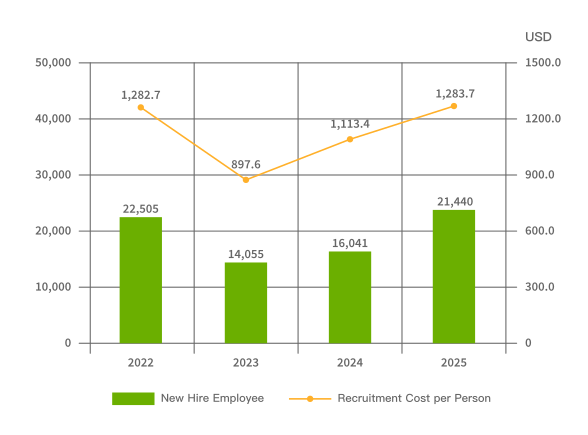
In 2025, ASEH recruited over 21,000 employees, of which 30.3% are engineering positions, 60.9% are skilled technical positions on the production lines, and 14.9% of female engineering employees. ASEH also supports recruiting people with disabilities, hiring 142 persons with disabilities in 2025.
As a global enterprise, we recruit a diverse pool of high-quality talents from all over the world. Helping foreign employees adapt and retaining talent at the workplace are our top priorities. In 2025, we hired over 6,000 new foreign employees. Our subsidiaries provide new hires with interpreter service and also assign them with senior foreign employees from the same country so as to help them adjust to their new work environment and familiarize themselves with the local culture. Foreign employees are also provided educational training programs in languages they understand, and they are accorded the same benefits as local employees. Our global and diverse talent recruitment policy has helped us improve the company’s global advantage and competitive capabilities, thus allowing us to meet the market needs of an increasingly diverse customer base. We believe that a workplace culture defined by diversity and inclusion, will allow employees to grow and develop mutual respect, resulting in a genuinely inclusive work environment.
Employee Turnover
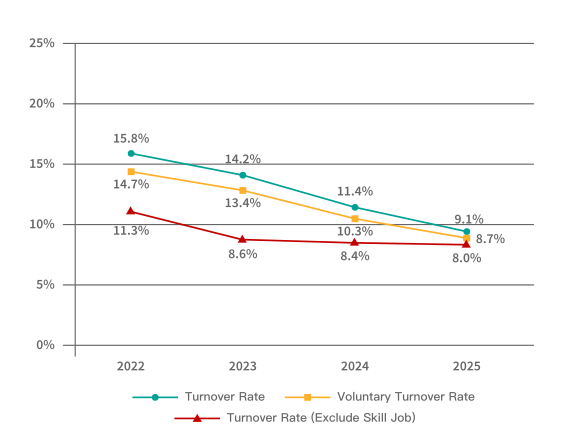
Employee turnover at ASEH was 9.1% in 2025, a 2.3% decrease from the previous year. The turnover at our facilities in Taiwan was 7%. The employee turnover rate at ASEH is broken down into 55.4% male vs 44.6% female. In terms of job types, production line skill job positions form the majority with 57.4%, while management, engineering and administrative positions formed the remaining 42.6%.
On a biannual basis, ASEH conduct employee engagement surveys to encourage feedback and opinion sharing from employees. ASEH also perform annual analyses on the causes of attrition for different job types, with deep-dive analyses finding that turnover was mainly attributed to factors such as remuneration, career growth and personal reasons, and correspondingly developing improvement projects and long-term talent retention and development strategies. As a technology company, we apply big data analytics to identify underlying and correlating factors that affect turnover and extrapolate behavioral factors that contribute to talent attrition. The analysis combines other factors such as regional attributes and challenges, to identify talent retention risks and project potential employee turnover rates. A deeper understanding of the dynamics affecting turnover will help the company to formulate strategies to manage the risks for retaining talent. Meanwhile, for facilities with high turnover among new hires, various actions will be adopted to help employees adapt to their work environment and prevent the depletion of human capital.
Talent Retention
Retaining top talent is one of the primary drivers of ASEH’s growth and momentum. ASEH provides a conducive environment for employees to unleash their full potential, create innovative technologies, and demonstrate effective management skills. To support talent retention, ASEH implements four key strategies: "Highly Competitive Compensation and Benefits," "Fair and Comprehensive Performance Review," "Open Communication and a Grievance Mechanism," and "A Multi-Faceted Employee Engagement Survey."
Compensation and Benefit Policy
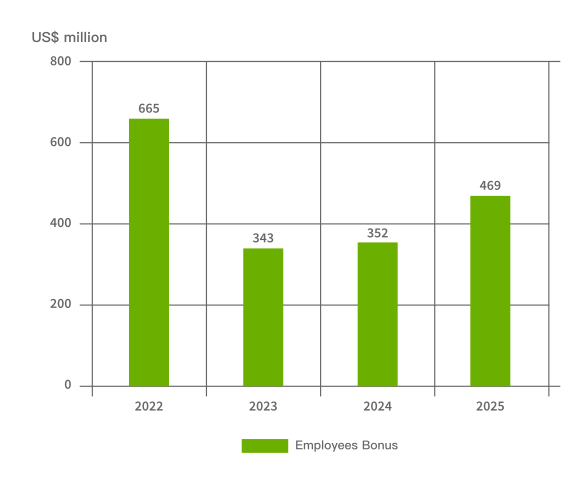
ASEH provides competitive remuneration packages that consist of base salary, subsidies, employee cash bonuses and other compensation based on a combination of the company’s achievements of business objectives and profitability, as well as the employees’ job responsibilities, professional qualifications and job performance etc. Employee remuneration is not determined based on factors such as gender, age, race, nationality, religion, political stance or gender identity. In order to attract and retain talent, and reward performing employees, the company has established monthly incentive and annual profit-sharing bonuses. Monthly cash incentive bonuses are provided to employees with outstanding performance based on the company's operating goals and profitability, while annual profit-sharing bonuses vary according to the employee’s individual contribution levels and performance. In 2025, ASEH’s employee bonuses amounted to US$469 million (including monthly incentive and annual profit-sharing bonuses), with the accumulated total from 2017 to the end of 2025 reaching over US$3.4 billion. In addition, employees with outstanding performance are awarded company stock options, which are aimed at retaining exceptional employees.
To alleviate the burden on employees, ASEH has built a comprehensive leave management system in alignment with the various local government policies on parental leave. We proactively provide employees with information on labor insurance and subsidies, and assist them with the leave application procedure.
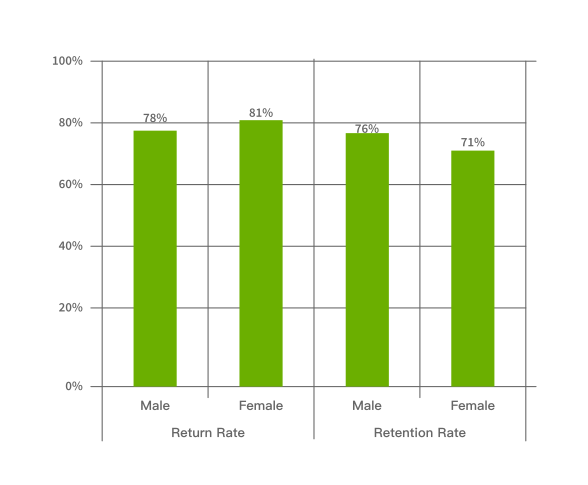
A total of 3,806 ASEH employees were on parental leave in 2025, including 813 on unpaid leave. Among the 736 workers expected to return to work, 588 actually returned, equivalent to a 79% return rate and a 73% retention rate. The number of newborn children at all facilities in 2025 was 1,628. Of the total number, 1,084 were from the Taiwan sites, accounting for 1% of all newborns in Taiwan. The data demonstrated the success of the company's comprehensive parental care and benefits allowing our employees mind plan a for a family and the peace of mind to raise children.
ASEH has implemented a number of maternity benefits that go above and beyond the legal requirements ranging from maternity leave, paternity leave, prenatal check-up leave, childbirth subsidies, to childcare allowances. These initiatives are intended to support employees’ work-life balance, and encouraging more childbirth while at the same time, helping to address Taiwan’s aging population trend.
Maternity Benefits
Paid Maternity Leave (For the Primary Caregiver)
ASE: Female employees at the ASE Kaohsiung and ASE Chungli facilities are entitled to paid maternity leave of 10 weeks, exceeding the statutory requirement of 8 weeks. They can also apply for an additional 24 weeks of parental leave at 80% of their insured salary
Paternity Leave and Paternity Check-up Leave (For the Non-primary Caregiver)
ASE: Paternity/prenatal check-up leave for employees at the ASE Kaohsiung and Chungli facilities was extended from the legally mandated 7 days to 10 days. Employees can also apply for an additional 24 weeks of parental leave at 80% of their insured salary
Congratulations leave
ASE Malaysia offers a one-day congratulatory paid leave a day after an employee’s new born child
Childbirth Subsidies
ASE: ASE Kaohsiung and ASE Chungli offer a child birth subsidy of NT$10,000 per child
SPIL: SPIL plans to offer a child birth subsidy of NT$3,600 per child
USI: USI offers a child birth subsidy of NT$6,000 per child
Childcare Allowance
ASE: Childcare facilities established in ASE Chungli and ASE Kaohsiung in Taiwan, and ASE Korea
SPIL: SPIL offers a monthly subsidy of NT$5,000 per child (NT10,000 if both husband and wife work at SPIL) aged 0-6 years-old
Breastfeeding and Maternal Health
Our facilities have dedicated on-site breastfeeding rooms that provide a private, comfortable and safe environment for breastfeeding employees
A one-hour breast milk expression break is provided for employees per day. If employee’s overtime exceeds one hour, an additional 30 minutes’ break will be granted. The expression time can be used multiple times within the allocated period and is counted as regular working hours
We launched a “Workplace Maternal Health Protection Program,” providing comprehensive health protections for employees who are pregnant, within one year postpartum or breastfeeding. Through one-on-one interviews and job evaluations, we ascertain employee needs and provide follow-up care. Relevant support measures based on workplace health hazard assessments are provided to pregnant employees, including job reassignments during pregnancy, maternity benefits, and reinstatement after maternity leave. We also established other pregnancy-friendly measures, including antenatal classes for new parents, a maternity mailbox, and accessible parking, to ensure the workplace safety and health of all pregnant and postpartum employees, thereby creating a supportive and friendly workplace for pregnant women
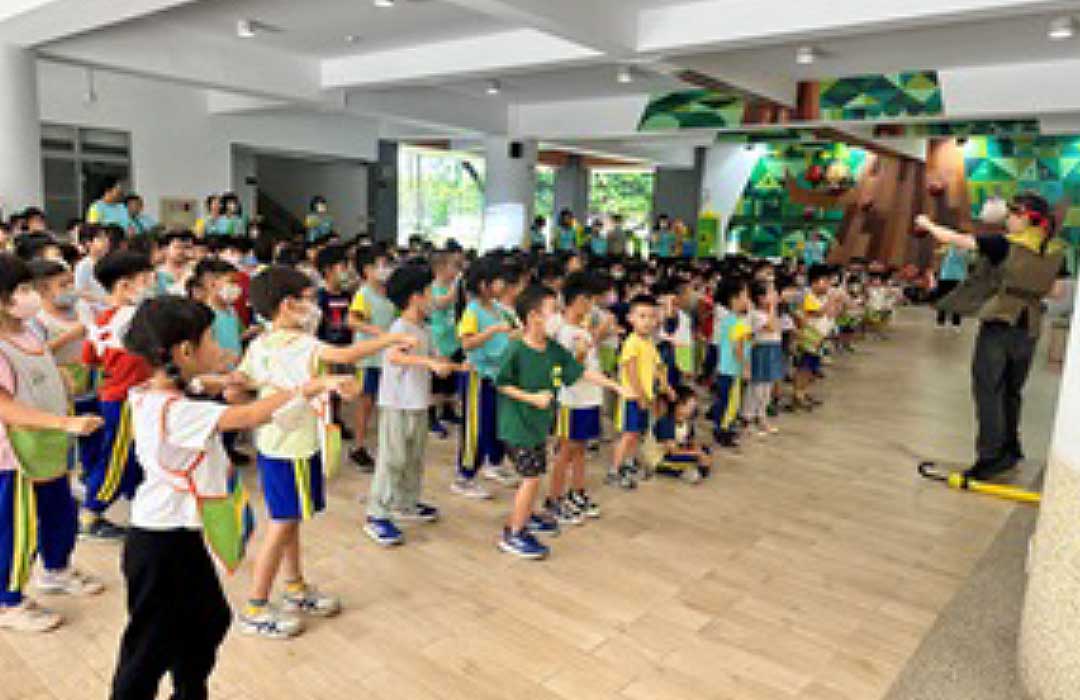
ASEH has 3 facilities worldwide that have set up childcare facilities within their premises – ASE Chungli and ASE Kaohsiung in Taiwan, and ASE Korea.
The ASE kindergartens and childcare centers provide high-quality and affordable education and day care services for employees. To adjust to employee work schedules, our kindergartens operate flexible hours with the nursery operating from 7am to 8pm so that our employees do not need to worry about their children while at work. The ASE childcare and kindergartens are an extension of our employee-care management and we will continue to implement programs that support family values and strengthen employees’ loyalty.
Flexible working hours are offered to employees based on the nature of their work and personal needs (including family care or on-the-job training) to meet the requirements of different job characteristics, work hours or time zones and personal needs. Our employees may apply for flexible working hours according to their actual needs, and submit their application to their supervisor for evaluation and approval. Flexible work schemes have been implemented at ASE facilities in Chungli, Shanghai (Material), Japan, Malaysia, ISE Labs, as well as USI facilities.
Flexible Work Hours
Providing flexible working hours based on the nature of work and personal needs (including family care or on-the-job training) to meet the requirements of different work hours or time zones. Our employees may apply for work hour adjustments with their supervisor’s approval. Flexible work hour schemes have been implemented at ASE facilities in Chungli, Japan and Singapore, as well as USI facilities.
Employees are allowed to apply for flexible work arrangements due to health or other personal reasons.
Attend to work duties during scheduled hours, while allowing work flexibility beyond that.
Maintain flexibility to adjust working hours. Employees are allowed to end their work day whenever they have completed the day’s task.
Work from Home
ASE Japan, ISE Labs and USI : Designed a set of policies/guidelines to allow eligible employees to apply for work from home (remote) on a short or long-term basis.
Part-time Working
ISE Labs has formalized the procedures for part-time employment that provides eligible part-time employees with the same employee benefit protections as regular employees. Part time employees are those who are contracted to work less than 30 hours a week.
Defined Benefit Plan
The retirement system in our Taiwan sites governed by the Labor Standards Act is a government-managed defined benefit plan. Employee pension payments are calculated based on the years of service and the average monthly salary of the six months prior to the approved retirement date. Taiwan sites contribute a fixed percentage of employees' total monthly salaries into the workers' pension reserve fund, which is deposited under the name of the Supervisory Committee of Workers' Retirement Reserve Funds into a designated account at the Bank of Taiwan.
Defined Contribution Plan
The retirement system in our Taiwan sites governed by the Labor Pension Act is a government-managed defined contribution plan, where 6% of an employee's monthly wage is contributed to an individual account at the Bureau of Labor Insurance. Operating sites in Mainland China, the United States, Malaysia, Singapore, and Mexico also make contributions to relevant government agencies in compliance with local regulations.
All ASE employees are enrolled in national labor insurance as well as group insurance, which covers life insurance, accidental injury insurance, medical insurance, cancer insurance, and other enhanced protections. In addition, business travel insurance is provided, along with free group insurance for employees' spouses and children.
We care deeply about our employees' physical health and provide free health check-ups at designated clinics, contracted hospitals, and health screening centers. Fully equipped fitness centers are available across many of our sites. Furthermore, massage centers are provided to help employees relieve fatigue and ease stress.
To promote ASEH's vision of ensuring fair compensation and living wages, we have adopted the International Labour Organization (ILO) Declaration on Fundamental Principles and Rights at Work and the fair wage principles advocated by the Fair Wage Network. To that end, we have completed a living wage survey for frontline employees across our global operations.
Performance Management
We consider performance management a means to improve the performance outcome and value of individuals, organizations, and the company as a whole. ASEH adopt a multi-dimensional performance management system to evaluate employee job performance which is conducted twice a year for all employees. Inaddition to receiving timely feedback from their immediate supervisors based on the evaluation, employees can also obtain cross-departmental suggestions from senior management or colleagues. The performance evaluation focuses on individual achievements and goals, and team goals. These assessments serve as the basis foremployee promotion, training and development, and compensation. Our evaluation incorporates various approaches which include management by objectives, multi-dimensional performance appraisal, team-based performance appraisal, and agile assessments. Development plans are formulated accordingly after the employees and their supervisors identify areas for improvement in their current roles or future career plans. For employees experiencing performance gaps, supervisors will provide immediate feedback and targeted coaching. Supervisors will be focused on assisting the affected employees to maximize their efficiency in their job rolesand responsibilities.
Employee Communication
ASEH values and respects the opinions and rights of its employees. In an effort to promote open and transparent communication, the company has established comprehensive communication channels including unidirectional and bidirectional communication modes. Employees are able to receive the latest news about the company and express any opinions or concerns they may have about the workplace. To protect and ensure employees’ rights and implement a fair and impartial grievance management mechanism, employee opinions may be submitted anonymously.
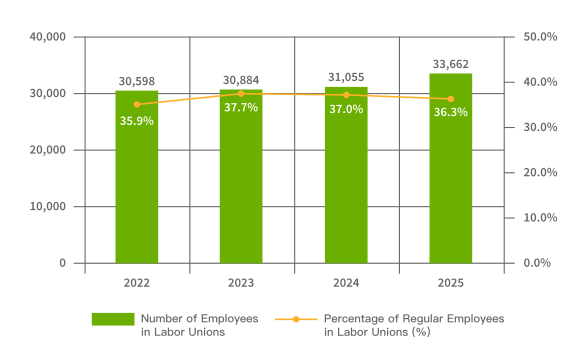
Meanwhile, ASEH recognizes employees’ right to freedom of assembly and association. As of the end of 2025, the total number of union members was 33,662, accounting for 36.3% of all ASEH regular employees.
Employee Sustainability Engagement Surveys
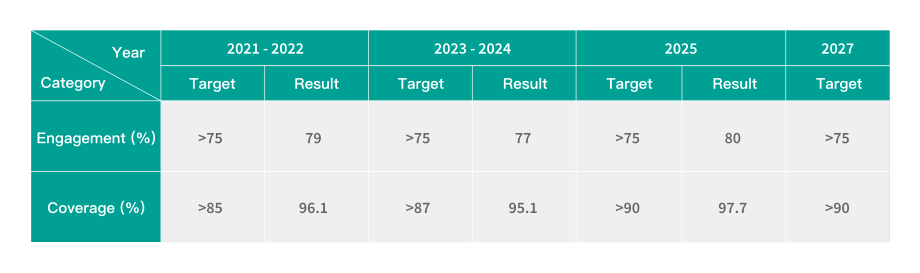
85,184 employees from our 3 major subsidiaries (28 locations across 10 countries), participated in the 2025 sustainability engagement survey, recording a coverage rate of 97.7%. The overall satisfaction rate was 80%, exceeding our 75% target. Moreover, overall engagement among direct employees has improved compared with that in 2023, reflecting the effectiveness of our employee management policies. Of the various topics surveyed, “proud to be part of the company” was rated highly by employees, indicating a strong sense of belonging and identification with the organization and its corporate culture and values. Collecting employee feedback and analyzing the results are extremely useful for us to understand how our employees feel about their role, work environment, leadership, compensation structure and other factors. It allows us to calibrate policies and implement robust support systems to build an organization with purpose, and improve both culture and business performance.
Other topics
Other topics
